
10 min read
The Verdict: boAt Didn’t Get Lucky. They Got Systematic.
Every brand in India wants to run a flash sale. Maybe three brands actually know what a flash sale is for.
boAt is one of them.
When boAt drops a limited-edition colourway or opens a 48-hour sale window on Flipkart, products sell out in minutes. Not because demand is naturally that high. Because boAt has spent years engineering a specific neurological response in its customers. They’ve built what I’m calling The Urgency Architecture: a layered system of scarcity signals, social proof, and identity triggers that turns casual browsers into frantic buyers before the rational brain has a chance to intervene.
This is a masterclass in boAt marketing strategy in India. Not because they invented scarcity. Because they systemised it better than anyone else in this market. Let’s go four layers deep.
India TWS Market Share
Valuation
Products Sold
India Wearable Brand
The Anatomy of a boAt Drop: What You Actually See
You’ve seen it a hundred times, even if you never noticed the pattern.
Step one: a celebrity endorsement drops. Hardik Pandya posts with a new colourway. The product doesn’t exist in retail yet. Step two: the pre-announcement. boAt posts on Instagram. “Coming soon.” The product gets a limited quantity tag and a launch date. Comments fill up. The crowd assembles before the doors open. Step three: sale opens on Flipkart or Amazon. Countdown timer. “Only X units available.” The number moves in real time. FOMO compounds. Step four: sold out. Social media lights up with “missed it” posts that function as free advertising. Step five: the next drop is announced within days. The cycle restarts.
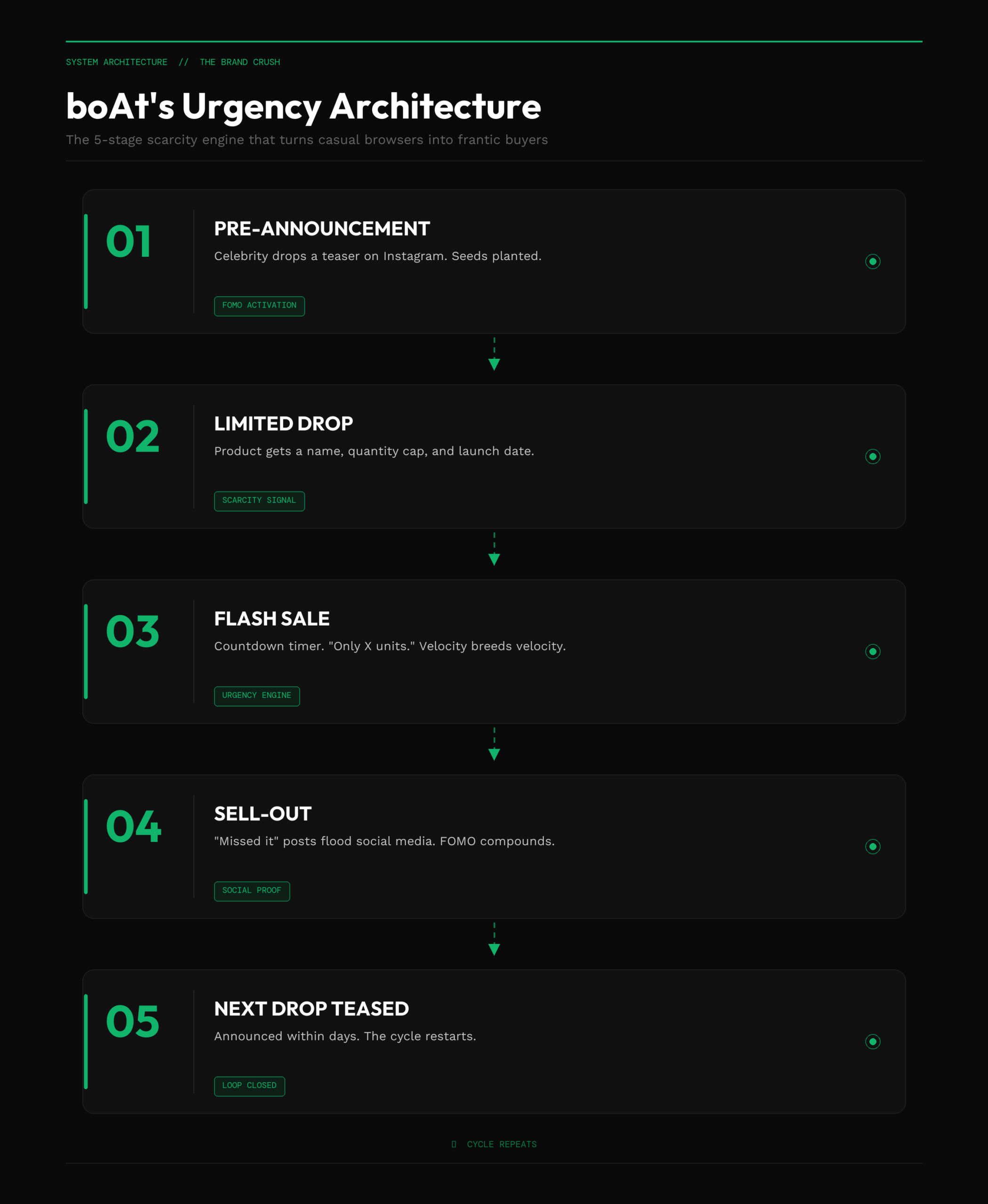
That’s the surface. The actual mechanics underneath are considerably more deliberate.
The Urgency Architecture: boAt’s Named Playbook
The Urgency Architecture is a three-part system running before the sale, during the sale, and after the sale. Most brands attempt one of the three parts. boAt runs all three simultaneously, and that’s the difference between a flash sale and a flash sale that shapes brand identity.
Part One: Pre-Sale Desire Construction
boAt doesn’t just sell products. They sell anticipation. When a 22-year-old guy sees Pandya wearing Airdopes 141 in a specific colourway, the purchase decision isn’t “do I need earphones.” It’s “do I want to be the kind of person who has what Hardik has.” The limited-edition colourway strategy is similarly precise – colours tied to cultural moments, sports seasons, and celebrity aesthetics. The product becomes a badge. By the time the sale opens, the customer has already emotionally committed. The sale is just the transaction.
Part Two: In-Sale Friction Amplification
The countdown timer is not a convenience feature. It’s a psychological weapon. When you see a timer counting down to zero, your brain activates the same threat-response circuitry it uses for genuine emergencies. Heart rate ticks up. Decision-making speed increases. Deliberation time decreases.
boAt pairs the countdown timer with quantity indicators: “Only 843 units left.” That number moves. Watching it move creates social proof of demand in real time. You’re not just seeing that a product is limited. You’re watching other people buy it. It answers the question every uncertain buyer asks: “Is this actually worth it?” The answer isn’t “yes, because the product is good.” It’s “yes, because 157 people just bought it in the last three minutes.”
boAt doesn’t manufacture fake scarcity. They manufacture real scarcity at scale. That distinction is the entire playbook.
Part Three: Post-Sale Identity Reinforcement
When a sale sells out, boAt wins twice. First, they move units. Second, they generate a second wave of organic reach from every person who posts “missed it” or “got it.” The sold-out announcement is content. The envy it creates is advertising. People who got the product post about it because owning a limited-edition item is worth posting about. People who missed it post because scarcity creates emotions strong enough to share.
boAt doesn’t have to pay for this second wave. The architecture generates it automatically. Scarcity creates desire, desire creates urgency, urgency creates purchases, purchases create social signals, social signals create desire in new audiences. The loop continues into the next drop.
The Psychology Layer: Why Your Brain Falls For It Every Time
Loss Aversion Over Acquisition Desire
Daniel Kahneman’s research established that losses feel roughly twice as painful as equivalent gains feel pleasurable. boAt’s flash sale mechanic exploits this directly. The framing isn’t “you could gain a great product.” It’s “you could lose the chance to get this product.” Missing out feels like a loss. And losses hurt more than gains feel good. This is why “limited edition” converts better than “new product” even when the underlying item is identical.
Social Proof Under Uncertainty
Indian consumers buying consumer electronics in the ₹1,000-₹5,000 range are often genuinely uncertain about quality. When they can’t evaluate quality directly, they use social proof as a proxy. Watching units sell in real time is the strongest possible social proof signal. You didn’t research the product. You watched a thousand people buy it simultaneously. That’s good enough for most purchase decisions at this price point.
Identity Congruence and the Badge Premium
boAt’s celeb partnership strategy isn’t random. They consistently partner with athletes and performers who index high with their core demographic: young, aspirational, male-skewing, sports-interested Indian consumers aged 18-34. When a product becomes associated with an aspirational identity, the purchase isn’t a financial transaction. It’s an identity expression. Consumers who wouldn’t pay ₹2,000 for earphones will pay ₹2,000 for earphones that signal membership in a group they want to belong to. This is the mechanism behind every successful festive season marketing play in India: convert the purchase from a financial decision into an identity decision, and price sensitivity dissolves.
The System Layer: boAt Didn’t Invent This. They Perfected It for India.
Flash sales aren’t a boAt invention. Xiaomi ran the Mi Flash Sale model from 2014. OnePlus used invite-only purchasing to manufacture exclusivity. Supreme turned scarcity into its entire brand identity. What boAt did was take a proven global system and optimise it specifically for Indian consumer psychology and e-commerce infrastructure.
First: platform dependency as a feature. boAt runs flash sales exclusively through Flipkart and Amazon. Both platforms have built-in countdown mechanics, real-time inventory display, and push notification infrastructure that boAt gets for free. They don’t build the Urgency Architecture from scratch. They plug into trusted infrastructure.
Second: price point precision. boAt operates primarily in the ₹999-₹3,999 range for its highest-volume products. This price range sits below the deliberation threshold for most of their target demographic. At ₹1,499 during a 48-hour sale, the urgency mechanics override rational deliberation entirely.
Third: cricket season alignment. boAt’s Hardik Pandya partnership and IPL sponsorships time limited drops around cricket moments when their target demographic’s emotional engagement is already elevated. Elevated emotional states amplify urgency responses. This is the same playbook Dream11 runs through fantasy sports: capture the consumer when they’re already emotionally activated, then redirect that activation toward a purchase.
System Insight
The villain in boAt’s playbook isn’t boAt. It’s the broader system of engineered urgency that the entire Indian consumer electronics market now runs on. boAt perfected it. Noise copied it within 18 months. So did pTron, Realme, and a dozen others. What was a competitive advantage in 2019 is now industry standard in 2026. The system spreads. That’s what systems do.
The Counterargument: “Isn’t This Just Good Marketing?”
The argument goes: boAt makes genuinely good products at genuinely accessible price points. Their flash sale mechanics don’t deceive customers because the products deliver real value. The scarcity is often real. The demand is often genuine. If consumers enjoy the experience and are satisfied with the product, who’s harmed?
This is partially correct. Here’s where it breaks down. The Urgency Architecture is designed specifically to bypass deliberate decision-making. It works by triggering threat-response circuitry and redirecting it toward a purchase. The consumer who buys because the timer hit zero didn’t make a considered decision. They made a panic decision that happened to result in a product they’re probably fine with. “Probably fine with” is a low bar.
The deeper problem is what it does to the broader market. When The Urgency Architecture becomes the dominant model, every brand that doesn’t use it loses competitive ground to brands that do. One brand optimises for compulsion, the entire category follows, and the floor drops for everyone – exactly the dynamic we’ve seen with Swiggy’s gamification mechanics.
So: is it good marketing? Yes. Does it have costs beyond the individual transaction? Also yes. Both things are true.
Real Scarcity vs. The Flash Sale Illusion
There’s a meaningful difference between real scarcity and manufactured scarcity. boAt, to their credit, mostly runs the first one.
Real scarcity: the product genuinely has limited units. The sold-out status is accurate. The countdown reflects actual stock. When boAt says 843 units, there are 843 units. The Flash Sale Illusion: artificially constrained stock on a product with unlimited availability. The “only 50 left” banner on a product with 50,000 units in the warehouse is a lie.
boAt’s model is credible because their limited-edition drops are actually limited. The colourways don’t come back. The scarcity is real, which means the urgency it creates is earned. Customers who missed a genuinely limited product come back for the next drop. boAt has built a repeat purchase culture on top of a scarcity model because the scarcity is honest.
Most Indian brands attempting to copy boAt’s playbook miss this entirely. They see the countdown timer and copy the countdown timer. They don’t see the genuine product limitation underneath it that makes the timer credible. The result is a campaign that converts once and damages trust permanently. Compare that to how Amul uses price anchoring honestly: the mechanism is visible, the value is real, and the brand compounds trust rather than spending it.
Is Your Brand Using Real Scarcity or The Flash Sale Illusion?
Run your next campaign through these six checks before you hit publish. If you fail more than two, you’re running the Illusion, not real scarcity.
- Unit count honesty: Is the “only X left” number accurate to actual available stock? Not warehouse stock, not potential stock. Actual committed stock for this sale.
- Non-repeatability: Will this exact product, at this exact price, in this exact configuration genuinely not be available again? If you’re planning a restock within 60 days, it’s not limited edition.
- Timer accuracy: Does the countdown reflect a real deadline? Not a deadline that resets when it hits zero.
- Demand authenticity: Is there actual consumer demand for this product at this price independent of the urgency mechanics? Remove the timer. Would people still buy it?
- Post-sale consistency: After sold-out status, do you honour it? Or does the product quietly reappear at the same price a week later?
- Identity alignment: Is your scarcity tied to a genuine cultural moment or celebrity association that creates real badge value? Or is it just a colour variant with a “limited” label?
Pass all six: you’re running real scarcity. Fail any two or more: you’re running the Flash Sale Illusion. The second one works once. The first one compounds.
What to Actually Steal From boAt’s Playbook
Steal: The Three-Phase Architecture
Pre-sale desire construction, in-sale urgency amplification, post-sale identity reinforcement. Most brands invest entirely in the middle phase and wonder why their flash sales don’t build cumulative momentum. The pre-sale phase builds the audience. The post-sale phase converts that audience into your next sale’s pre-sale phase. Without both bookends, you’re running a one-time promotion, not a system.
Steal: Platform Leverage Over Platform Building
boAt doesn’t run flash sales on their own website. They run them on Flipkart and Amazon because those platforms have built-in urgency infrastructure, trusted payment flows, and existing customer bases. Building your own urgency mechanics is expensive and takes time to earn trust. Plugging into trusted infrastructure is faster and more credible.
Steal: Identity Alignment Before Urgency Deployment
The celebrity partnerships, the colourway choices, the cultural moment timing: all of this happens before the urgency mechanics activate. The identity connection is what makes the urgency feel urgent. Without identity alignment, a countdown timer is just a timer. Nobody panics about missing something they didn’t want to begin with.
Don’t Steal: The Flash Sale Illusion
If you can’t genuinely constrain supply, don’t pretend you have. The Indian consumer is more sophisticated than most brands give them credit for. Indian content marketing has a trust deficit already. Manufacturing fake scarcity accelerates that deficit for your brand specifically. Don’t steal the surface. Steal the system.
You just went four layers deep into the most sophisticated scarcity playbook in Indian consumer marketing. There’s more where this came from. Every week, we dissect the campaigns Indian brands don’t want analysed. Subscribe for the unfiltered version.
Sources: Counterpoint Research, India Wearable Market Share Report Q4 2024, boAt TWS market dominance data. IDC India Quarterly Wearable Device Tracker, 2024, India wearables category rankings and unit shipment data. Kahneman, D. and Tversky, A., “Prospect Theory: An Analysis of Decision under Risk,” Econometrica, 1979, loss aversion coefficient research. boAt Lifestyle company filings and investor documentation, valuation and units-sold figures. Flipkart and Amazon India product listing archives, flash sale mechanics and countdown timer usage patterns.



1 Comment