The Whole Truth just turned a 1993 Bollywood banger into the most honest protein ad India has ever seen. The brand took “Choli Ke Peeche Kya Hai,” a song so provocative it was banned from Doordarshan and All India Radio, and flipped it into “Protein Ke Peeche Kya Hai?” In 45 seconds, shirtless bodybuilders dance out of a giant protein tub, ripping apart an entire industry’s playbook. The brand reported Rs 220 crore in revenue with a Rs 2,100 crore valuation, built almost entirely on one principle: tell the truth, make it impossible to ignore.
Most D2C brands in India spend millions trying to look credible. The Whole Truth spent the budget making competitors look ridiculous. This is a breakdown of why the ad works, what it is really attacking, and why it might be the smartest piece of brand marketing in India right now.
Full disclosure up front. This is independent analysis and opinion. Nobody paid for this take.
India’s protein market is booming, and full of fakes
Protein supplement market size, USD billion
India protein market valued at $1.52B in 2025, projected $2.08B by 2030 at 6.52% CAGR. Source: Mordor Intelligence.
Why remix “Choli Ke Peeche Kya Hai” for a protein ad?
Because the original song asked a question everyone already knew the answer to. And that is exactly the point.
“Choli Ke Peeche Kya Hai” has been in the top charts since the early ’90s. The song from Khalnayak (1993) was controversial, catchy, and unforgettable. It was the kind of track your parents pretended to disapprove of while humming it in the kitchen. Doordarshan banned it. All India Radio banned it. People played it louder.
The Whole Truth’s founder Shashank Mehta and agency Manja took that exact cultural energy and pointed it at protein powder. “Protein Ke Peeche Kya Hai?” Same melody. Same playful scandal. Completely different target. Now the question is not about a blouse. It is about what brands are hiding inside those big, intimidating jars.
The genius is the format. The Whole Truth knows something most health brands refuse to accept: people will not read a detailed blog about what goes into a protein powder. They will not study an ingredient list. They will not sit through a 10-minute explainer video about amino spiking. But they will absolutely listen to a catchy song. They will hum it. They will send it to their gym buddy. They will remember “Protein Ke Peeche Kya Hai?” the next time they pick up a black tub at a supplement store.
That is not just clever. That is strategically precise.
People will not read a detailed blog about what goes into a protein powder. But they will absolutely listen to a catchy song. They will hum it. They will send it to their gym buddy.
What is the ad actually attacking?
Everything. The entire aesthetic, packaging, and marketing language of the Indian protein industry.
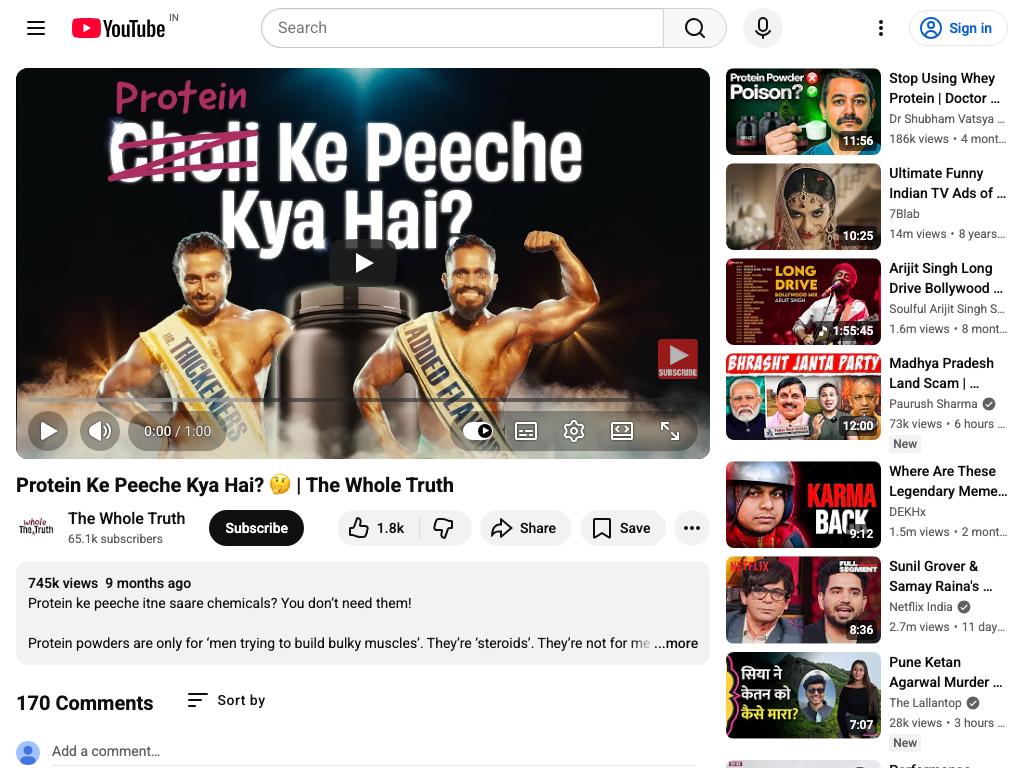
The ad opens with half-naked bodybuilders bursting out of an oversized protein tub. They are dancing, flexing, performing the exact hypermasculine theatre that every protein brand in India uses to sell you powder. It is a parody, but it is barely exaggerated. Walk into any supplement store and the vibe is exactly this: hulking men on posters, aggressive fonts, and promises of gains.
Then the lyrics land. Instead of suggestive Bollywood innuendo, these guys are singing about artificial sweeteners. Thickeners. Heavy metals. Amino-spiking agents. All the things that a Citizens Protein Project study found are hiding in 69.4% of protein supplements tested, with 9 of 36 products containing less than 40% of the protein they claimed on the label.
Let that sink in. Nearly 7 out of 10 products are mislabeled. Actual protein content can be 10 to 50% lower than advertised. The industry is not just misleading. By the numbers, it is fabricating.
Why are the big, black jars the real punchline?
This is the detail that makes the ad surgical.
Mehta said it himself: protein powders are “sold from shady supplement stores, by bulky, hulk-like men, and always in big, intimidating black boxes.” That line is not throwaway observation. It is a strategic strike aimed directly at brands like MuscleBlaze and their ilk, the entire category of aggressive, dark-packaged, gym-bro-coded supplements that dominate India’s protein market.
The big black jar is the protein industry’s security blanket. It signals “serious” and “powerful” and “professional grade.” It also conveniently makes it harder to see what you are buying. The dark packaging, the complex labels, the walls of text in microscopic fonts on the back. All of it is designed to make you trust the brand instead of reading the ingredients.
The Whole Truth’s own packaging is the opposite. Simple. Clean. Every ingredient listed on the front of the pack, in plain language, in a font you can actually read. No dark colours. No aggressive branding. No hiding.
The contrast is the argument. You do not need the ad to spell it out. Just put the two products side by side and the black jar loses.
How crazy can this brand actually get?
This is not even the first time The Whole Truth has thrown punches above its weight.
The brand’s entire identity is built on being the anti-brand. Mehta once laid out his philosophy in a way that should be taught in every marketing class: “If they use sexy models, we will use an un-sexy founder. If they put food porn on the pack, we will not put any photo. If they make tall claims with star marks, we won’t make any claim at all. If they hide ingredients in a microscopic font at the back, we will declare them in a big bold font upfront.”
That is not a marketing strategy. That is a declaration of war. And it is working. Rs 220 crore revenue. Rs 2,100 crore valuation. Over 1 million monthly orders. 500,000+ Instagram followers driving 60% of all orders. A 2023 campaign exposing hidden sugars in rival brands boosted brand trust by 20%.
Most D2C brands play safe because they are terrified of lawsuits, bad PR, and alienating potential customers. The Whole Truth plays reckless (with precision). They mock the industry, name the problems, and then sell you the solution. It is the marketing equivalent of showing up to a knife fight with the knife and the autopsy report.
Why does humour work better than education here?
Because the protein industry has an education problem it created itself.
For years, brands have sold protein through intimidation. Big men. Big claims. Big science-sounding words that no normal person understands. The result is a product category that most regular consumers find confusing and slightly threatening. Parents still worry about their kids taking protein supplements. Office workers think whey is “only for gym people.” The entire category has been walled off by its own marketing.
Arvind Krishnan, co-founder of Manja (the agency behind the ad), nailed it: “People are willing to pay attention to things that really draw and entertain them.” That sounds obvious. But in the protein space, nobody was doing it. Everyone was too busy flexing.
The “Choli Ke Peeche” parody does something no ingredient list can do. It makes protein powder feel approachable. Funny. Shareable. It takes the conversation out of the gym and into the living room. Mehta said that was the explicit goal, to “take the protein conversation away from gyms and into our living rooms.” The song is the vehicle. The honesty is the payload.
One commenter captured it perfectly: “A TVC-style ad after such a long time in the modern D2C space.” That nostalgia is not accidental. It is strategic. The Whole Truth borrowed a format (the big, cinematic ad film) that Indian consumers already love and trust, then stuffed it with a message the industry did not want anyone to hear.
What is the actual risk of this kind of campaign?
There is one, and Mehta knows it. If a viewer clicks away before the 45-second mark, they might think the ad is anti-protein. “Don’t take protein powder” is not the message. “Don’t take dirty protein powder” is. But the parody format means early exit viewers could walk away with the wrong takeaway.
It is a real gamble. In a market where India’s protein industry is valued at $1.52 billion (2025) and projected to hit $2.08 billion by 2030, you do not want to accidentally shrink the pie you are trying to eat from.
But here is why the gamble works: the song is too catchy to leave. That is the entire bet, and if the view-through rates are anything like the social engagement, it paid off. You do not close a tab when “Choli Ke Peeche” is playing. You never have. You never will.
The Real Number
A Citizens Protein Project study found 9 of 36 products contained less than 40% of the protein they claimed. Actual protein content ranged 10 to 50% lower than advertised. Nearly 7 out of 10 supplements were mislabeled. The black jars are not just intimidating. They are covering up a fabrication.
What should other brands steal from this?
Three things.
- Use culture, not content. The Whole Truth did not make a “content piece.” They made a cultural moment. The difference is that content gets watched. Culture gets shared, hummed, quoted, and remembered. If your ad does not have a chance of being sent in a WhatsApp group, rethink the format.
- Attack the category aesthetic, not just the competitors. The Whole Truth never named MuscleBlaze in the ad. They did not have to. They attacked the black jar, the hulking men, the shady supplement store. Everyone watching knows exactly who they mean. That is cleaner and more devastating than a direct callout.
- Make the truth entertaining, or it stays unread. This is the biggest lesson. The Whole Truth had the same transparency message for years. Ingredient lists on the front. No hidden chemicals. Clean label. But that message only reached health-conscious consumers who were already looking. The song reaches everyone. Your grandmother could hum “Protein Ke Peeche Kya Hai?” and she has never touched a protein shake in her life. That is reach no ingredient label can buy.
FAQ
What is The Whole Truth’s “Protein Ke Peeche Kya Hai” ad?
It is a 45-second satirical ad film by The Whole Truth Foods, created with agency Manja. The ad parodies the 1993 Bollywood hit “Choli Ke Peeche Kya Hai” from the film Khalnayak, replacing the provocative lyrics with questions about hidden ingredients in protein powders. Shirtless bodybuilders dance out of an oversized protein tub while singing about artificial sweeteners, heavy metals, and amino-spiking agents.
Who created the “Choli Ke Peeche” protein ad?
The Whole Truth Foods, an Indian clean-label food brand founded by Shashank Mehta, created the campaign in partnership with Manja, a creative agency co-founded by Arvind Krishnan. The brand reported Rs 220 crore in revenue and a Rs 2,100 crore valuation as of its latest reported figures.
What hidden ingredients does the ad expose in protein powders?
The ad calls out artificial sweeteners, thickeners, heavy metals, and amino-spiking agents commonly found in mainstream protein supplements. A Citizens Protein Project study published in PubMed found that 69.4% of protein supplements tested were mislabeled, with 9 of 36 products containing less than 40% of the protein they claimed.
Is The Whole Truth’s “Choli Ke Peeche” ad a dig at MuscleBlaze?
The ad never names any competitor directly. Instead, it satirises the entire category aesthetic of big, black jars, hypermasculine branding, and shady supplement stores. MuscleBlaze, as one of India’s largest protein brands with a similar packaging approach, fits the description. The attack is on the industry’s visual language, which makes it broader and more effective than a single-brand callout.
Why did The Whole Truth choose a Bollywood song for a protein ad?
Founder Shashank Mehta has said the goal was to “take the protein conversation away from gyms and into our living rooms.” The original “Choli Ke Peeche Kya Hai” was banned from Doordarshan and All India Radio for being too provocative, which guaranteed mass attention. The Whole Truth borrowed that cultural recognition to deliver a transparency message in a format people would actually watch, share, and remember, instead of a blog post or ingredient list that most consumers skip.
Watch the full ad: Protein Ke Peeche Kya Hai? | The Whole Truth (YouTube)
Subscribe to The Brand Crush for unsponsored breakdowns of what actually works (and what does not) in Indian marketing. No sponsored takes. No agency briefs. Just the real story.
Disclaimer: This analysis reflects The Brand Crush’s independent opinion. We are not affiliated with, sponsored by, or paid by The Whole Truth Foods, Manja, or any brand mentioned. All claims are sourced from publicly available data and clearly attributed. Opinions are our own.
Sources: The Whole Truth: Protein Ke Peeche Kya Hai? (YouTube). Revenue and valuation: The Hot Startups. Mislabeling study: MedBound Times (Citizens Protein Project via PubMed). Market size: BestMediaInfo (Mordor Intelligence). Brand strategy: Brands Pe Charcha. Campaign analysis: Mad About Marketing, aFaqs.